You’ve likely experienced that familiar ache in your neck or lower back after a long day at work—your body’s warning signal that your posture needs attention. Millions of office workers face chronic pain and reduced productivity due to poor alignment, yet few understand how to achieve ergonomically optimum body posture that prevents these issues. Proper body alignment isn’t about holding a rigid position but finding the natural balance where your skeleton supports you with minimal muscle effort. When your body rests in its optimal alignment, gravity flows through your structure without creating unnecessary tension, allowing you to work longer with less fatigue. This guide reveals practical, science-backed strategies to transform your posture and protect your long-term health.
Identify Your Postural Weaknesses Through Self-Assessment

Before correcting your posture, you need to understand your current alignment patterns. Most people develop unconscious postural habits that gradually pull their bodies out of optimal alignment. Stand sideways in front of a full-length mirror and check if your ear aligns vertically with your shoulder, your shoulder with your hip, and your hip with your ankle—this vertical line indicates proper alignment. Deviations from this line create strain points that accumulate damage over time.
Forward head posture represents one of the most common and damaging alignment issues, where your head protrudes significantly in front of your shoulders. For every inch your head moves forward, it effectively doubles in weight to your supporting neck muscles—turning a 10-12 pound head into a 20-24 pound burden. Rounded shoulders often accompany forward head posture, creating a domino effect that flattens your natural spinal curves and transfers stress to vulnerable areas. When viewed from the front, check for uneven shoulders or hips, which indicate muscular imbalances that require targeted correction.
How to Document Your Postural Baseline
Take photos of yourself from front, side, and back views while standing naturally—don’t try to “fix” your posture for these images. Compare these against ideal alignment markers: your ears should sit directly above shoulders, shoulders level with hips, and knees aligned over ankles. Pay special attention to your natural spinal curves—the gentle inward curve at your neck, outward curve at your upper back, and inward curve at your lower back. These curves exist to distribute mechanical stress efficiently; when they flatten or exaggerate, pain and dysfunction follow.
Common Postural Mistakes You’re Probably Making
Most desk workers unknowingly create postural problems through everyday habits. Crossing your legs while sitting shifts your pelvis out of neutral alignment, forcing compensatory curves up your spine. Leaning on one hip while standing creates muscular imbalances that become structural over time. Looking down at your phone for extended periods places tremendous strain on your cervical spine—holding this position for just 30 minutes equals carrying a 40-pound weight on your neck. Recognizing these subtle but damaging habits represents the first step toward meaningful correction.
Perfect Your Seated Posture for All-Day Comfort
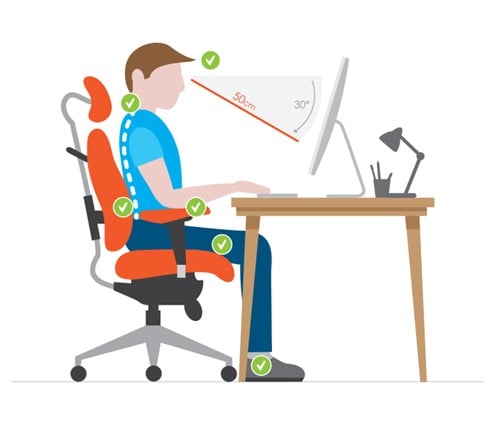
The foundation of ergonomically optimum body posture while seated centers on maintaining your natural spinal curves without exaggeration or flattening. Your hips should sit at or slightly above knee level, with thighs parallel to the floor or angled slightly downward. This positioning prevents posterior pelvic tilt—the backward rotation of your pelvis that flattens your lumbar curve and transfers stress to intervertebral discs. Your feet must rest flat on the floor to provide a stable base of support; if they dangle, your body compensates by tightening hamstrings and lower back muscles.
Optimal Monitor and Keyboard Positioning
Your screen’s top edge should align with your eye level, allowing you to view the center of the display without tilting your head up or down. Positioning monitors too low creates the forward head posture responsible for most neck and shoulder pain among computer users. For laptop users, this typically requires a laptop stand that elevates the screen to proper height with an external keyboard and mouse. Your keyboard should sit directly in front of you at elbow height, allowing your forearms to rest parallel to the floor while typing—this prevents shoulder elevation and wrist extension that lead to repetitive strain injuries.
The Critical Importance of Movement Breaks
Your body wasn’t designed for static positions maintained hour after hour; it evolved for regular movement and position changes. Set reminders to stand, stretch, or walk for 2-3 minutes every 30-60 minutes to interrupt the accumulation of strain. These brief breaks reset muscular tension and prevent the adaptation that occurs when tissues remain in one position too long. Even shifting your weight, adjusting your sitting position, or performing subtle pelvic tilts while seated provides valuable variation that protects your spinal health throughout the workday.
Optimize Standing and Walking Alignment Patterns
Ergonomically optimum body posture while standing distributes weight evenly across both feet, with your weight settling slightly forward onto the arches rather than collapsing into the heels. Your knees should maintain a soft, unlocked position—hyperextending backward creates joint instability and transfers stress to surrounding ligaments. Your pelvis rests in neutral alignment, neither tilted excessively forward nor backward, which allows your spine to maintain its natural curves without compensation.
Standing Desk Best Practices
When using a standing desk, position your monitor at eye level to prevent neck strain from looking up or down. Your keyboard and mouse should sit at approximately elbow height, allowing your arms to hang naturally with elbows bent at 90 degrees. Stand on an anti-fatigue mat that encourages subtle weight shifts rather than static positioning—your feet should feel engaged but not strained. Alternate between standing and sitting throughout the day to prevent the fatigue that develops from maintaining any single position too long.
Walking Posture Essentials
Each step should roll through your foot from heel to toe, with your arms swinging naturally at your sides in opposition to your leg movement. Maintain your gaze forward rather than downward at your feet—looking down even slightly encourages forward head posture that accumulates damage over time. Imagine a string pulling you upward from the crown of your head, allowing your shoulders to drop naturally away from your ears without rounding forward. This mental image helps counteract the hunching tendency that develops when we’re tired or distracted.
Build Postural Strength Through Targeted Exercises
Posture emerges from the balance between muscles that pull you into alignment and those that pull you out of it. Weak postural muscles lose this competition to tight, overactive muscles, creating the imbalances that manifest as poor posture. Building strength in key stabilizers creates lasting improvement that passive corrections cannot achieve.
Essential Postural Strengthening Exercises
Perform chin tucks throughout the day by drawing your chin straight back (creating a “double chin”) without tilting your head up or down—this strengthens the deep cervical flexors that combat forward head posture. Rows, face pulls, and scapular retractions build the upper back muscles that counteract rounded shoulders developed during hours of desk work. Planks, dead bugs, and bird dogs develop the deep core stabilizers that support your spine during upright activities—these muscles work continuously to maintain alignment during daily movements.
Stretching for Postural Balance
Doorway stretches open the chest muscles that have adapted to their shortened length from rounded shoulder positioning. Kneeling hip flexor stretches counteract the tightness that creates anterior pelvic tilt and lower back pain. Regular stretching combined with strengthening creates the muscular balance needed for sustainable postural improvement—addressing both sides of the equation prevents the recurrence of imbalances.
Create Long-Term Postural Success Through Daily Habits
Sustainable postural improvement requires embedding ergonomic principles into your daily life until they become automatic. Initially, maintaining proper alignment requires conscious effort; with consistent practice over months, your body defaults to better positioning without constant awareness. Pair postural checks with existing habits—every time you check email, every time you wait for the elevator—to build the repetition needed for new patterns to become ingrained.
Sleep Position Considerations
Your mattress and pillow selection either support or undermine the alignment you’ve worked to achieve during waking hours. Side sleepers generally maintain healthier spinal alignment than stomach sleepers, who must turn their head to breathe, creating cervical rotation that contributes to neck problems. Back sleepers benefit from a pillow supporting the natural curve of their neck without elevating their head excessively. Your mattress should support your body’s natural curves without allowing hips or shoulders to sink excessively, which throws off spinal alignment throughout the night.
Stress Management for Better Posture
When stressed, your muscles tense—particularly in the shoulders, jaw, and upper back. This chronic tension pulls your body out of alignment and creates muscle imbalances that perpetuate poor posture. Developing awareness of your stress responses and learning techniques like deep breathing or brief meditation can interrupt the stress-posture feedback loop before it causes lasting damage. Notice when you’re clenching your jaw or elevating your shoulders, and consciously release that tension throughout your day.
Achieving ergonomically optimum body posture requires consistent attention to your alignment patterns, targeted strengthening of postural muscles, and intentional workspace design. Start with one or two changes that seem most achievable—perhaps adjusting your monitor height or setting movement reminders—and build on your successes. Every moment you spend practicing better alignment contributes to a future of less pain, more energy, and a body that serves you well throughout your life. The cumulative effect of small daily improvements creates significant transformation over time—your spine will thank you for years to come.