Ever slid into a new car and immediately felt “at home,” with every control within natural reach and perfect visibility? That seamless experience doesn’t happen by accident—it’s the result of meticulous ergonomics in automotive design. When manufacturers get ergonomics right, drivers experience less fatigue on long trips, reduced distraction from poorly placed controls, and enhanced safety through optimized sightlines. As electric and autonomous vehicles reshape the industry, understanding ergonomics in automotive design has become critical for both manufacturers seeking competitive advantage and consumers evaluating their next vehicle purchase.
The stakes extend far beyond comfort. Poorly executed ergonomic design contributes to driver fatigue that increases accident risk by up to 20% according to industry studies. Vehicle attributes must be considered early in development through coordinated work of multidisciplinary teams to establish specifications that meet human needs. This early integration prevents costly redesigns later and ensures human factors drive engineering decisions rather than becoming afterthoughts. With modern vehicles containing over 100 individual controls and displays, getting the ergonomics right represents one of automotive engineering’s most complex challenges.
Position Driver Vision Using SAE J941 Eyellipsoid Standards
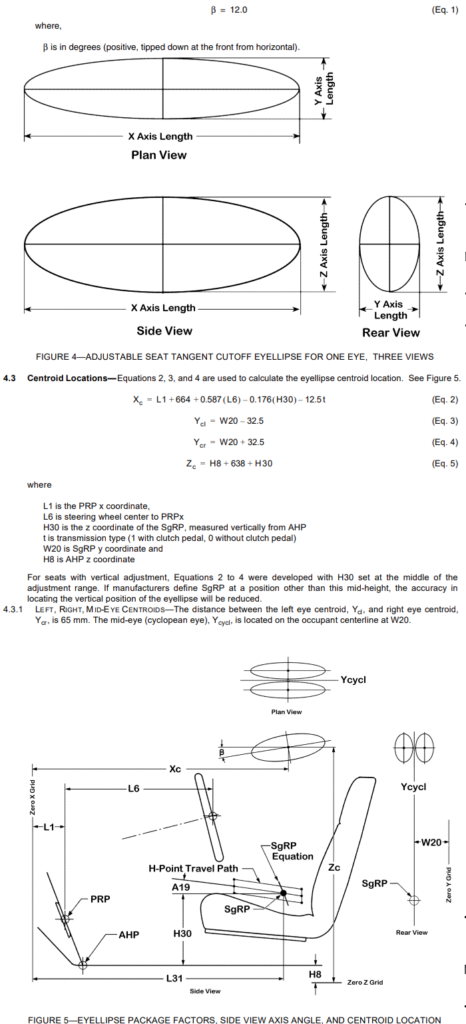
Automotive engineers use precise mathematical models to guarantee drivers can see critical elements without strain. The SAE J941 standard defines eyellipsoids—three-dimensional volumes representing where drivers’ eyes can be positioned—that serve as the foundation for visibility design. These models account for human variation by accommodating specific percentages of the driving population, with the 95th percentile configuration (covering 95% of drivers) being most common for passenger vehicles.
The standard establishes four distinct eyellipsoids based on percentile values (95th or 99th) and seat track length categories (shorter or longer than 133 mm). For the typical passenger vehicle configuration (95th percentile with track length >133 mm), the eyellipsoid dimensions are EX=206.4 mm, EY=60.3 mm, and EZ=93.4 mm. These measurements define the spatial volume within which 95% of drivers’ eyes will fall when properly seated, ensuring visibility requirements are met for the vast majority of users.
Calculate Exact Eye Position Coordinates for Your Vehicle
Determining where to place these eyellipsoids requires precise mathematical calculations based on your vehicle’s specific dimensions. Engineers use these formulas to position the left and right eyellipse centroids relative to the vehicle’s body reference point:
Xc = L1 + 664 + 0.587(L6) − 0.178(H30) − 12.5t
Ycl = W20 − 32.5
Ycr = W20 + 32.5
Zc = 638 + H30 + H8
Pro Tip: Remember that ‘t’ equals 0 for automatic transmission vehicles but becomes 1 for manual transmissions—a small detail that significantly impacts final positioning. The ellipsoids tilt downward 12 degrees to match natural driver gaze direction, ensuring sightlines to instruments and the road ahead remain unobstructed across the target user population.
Optimize Seatback Angle for Maximum Driving Comfort
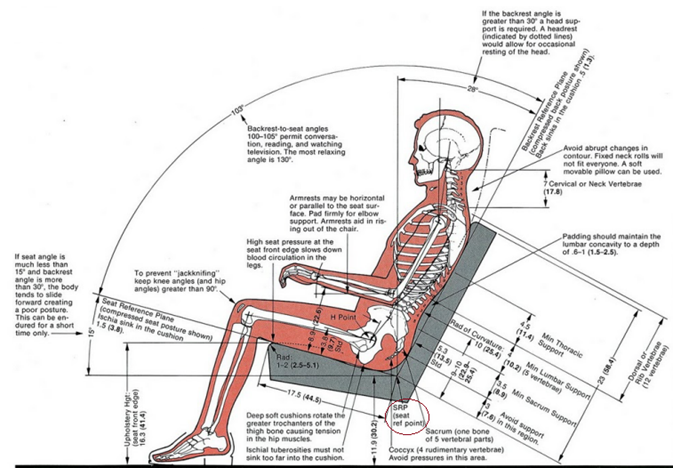
The seatback angle (designated A40 in SAE J1100) dramatically impacts spinal alignment, control reach, and fatigue levels during extended drives. This angle measures the recline of the seatback relative to vertical, with passenger car drivers typically preferring angles between 20-26 degrees. This slight recline accommodates the spine’s natural curvature while maintaining comfortable steering wheel reach and forward visibility—critical for reducing lower back strain on highway journeys.
Warning: Setting the seatback too upright (below 20 degrees) increases hip flexion and can cause premature fatigue, while excessive recline (over 26 degrees) compromises control access and emergency response capability. Truck drivers demonstrate different preferences due to higher seating positions, typically favoring more upright angles of 12-18 degrees for better forward visibility over the hood during long-haul operations.
Design Customizable Lumbar Support Systems That Prevent Back Pain
The lumbar region contour directly determines spinal curvature and long-term comfort. Effective lumbar support maintains the spine’s natural lordosis curve—the forward curvature of the lower back—preventing the fatigue and discomfort that develop during extended drives with inadequate support. Rather than offering one-size-fits-all solutions, leading manufacturers implement dual-axis adjustment systems that address two critical dimensions:
- Height adjustment: Positions the support at the correct vertical location for different torso lengths
- Protrusion adjustment: Customizes the fore-aft position to match individual spinal curvature
These adjustable systems accommodate diverse body types, allowing each driver to configure their seat to maintain personal lordosis. The ability to fine-tune lumbar support significantly reduces driving-related back fatigue, particularly on journeys exceeding two hours where static postures become problematic.
Solve Unique Ergonomic Challenges in Electric Vehicles
Electric vehicle platforms introduce fundamentally different packaging constraints that require rethinking traditional ergonomic approaches. With battery packs mounted beneath the floor and compact electric motors replacing bulky engines, interior space allocation and seating positions shift in ways that impact driver posture and comfort. The lower center of gravity from underfloor batteries alters vehicle dynamics, influencing preferred seat positions and support requirements.
Critical Consideration: EVs’ near-silent operation changes acoustic feedback patterns, making interior sounds more noticeable and requiring different material choices to manage cabin noise. Additionally, the absence of traditional engine compartments enables “frunk” storage but necessitates reevaluation of pedestrian protection systems and hood heights that affect forward visibility angles.
Redesign Interiors for Autonomous Driving Transitions
As vehicles gain autonomous capabilities, ergonomics must address activities beyond traditional driving. Future cockpits need to support work, rest, and entertainment while maintaining safety during mode transitions. Key challenges include:
- Developing interfaces that clearly communicate when driver intervention is required
- Creating seating configurations that safely accommodate reclined positions during autonomous operation
- Implementing occupant monitoring systems that verify attention levels before control handoffs
The shift from driver-focused to occupant-centric design requires fundamentally reimagining the vehicle interior. Manufacturers must balance the desire for flexible seating arrangements with the need to quickly return to traditional driving positions when autonomy disengages—a transition that must occur safely within seconds.
Evaluate Real-World Ergonomic Performance Before Production

Comprehensive evaluation methods prevent costly post-launch ergonomic failures. Effective assessment includes multiple dimensions beyond simple comfort metrics:
- Entry/exit ease: Measuring clearance and required effort
- Extended occupancy comfort: Identifying pressure points during simulated long drives
- Reach validation: Ensuring all controls remain accessible without compromising seated position
- Visibility verification: Confirming sightlines to instruments and critical road areas
Pro Tip: Conduct evaluations using both digital human modeling and physical prototypes with diverse test subjects representing your target demographic. Testing should include drivers from the 5th percentile female to 95th percentile male to ensure broad accommodation.
Implement Inclusive Design Strategies for Diverse Users
Modern vehicles must accommodate drivers with varying physical dimensions, abilities, and experience levels. Effective inclusive design requires:
- Selecting appropriate percentile targets based on criticality of each dimension
- Providing sufficient adjustment ranges for key parameters like seat height and steering reach
- Considering older drivers’ needs for enhanced visibility and simplified controls
- Addressing accessibility requirements for drivers with physical limitations
Designing for the 5th-95th percentile range ensures most users can operate the vehicle comfortably, but critical safety elements like pedal placement may require broader accommodation. Federal head restraint requirements often dictate minimum seatback heights, demonstrating how regulatory standards intersect with pure anthropometric considerations.
Balance Ergonomic Investments Against Development Costs
Ergonomic enhancements must deliver measurable benefits that justify their cost. Smart manufacturers prioritize features based on their impact on customer satisfaction and safety:
| Feature | Cost Impact | Customer Benefit | Priority |
|---|---|---|---|
| Adjustable lumbar support | Medium | High comfort improvement | High |
| Memory seat settings | High | Moderate convenience | Medium |
| Basic seat adjustments | Low | Essential accommodation | Critical |
| Advanced haptic feedback | High | Safety enhancement | High |
Warning: Cutting corners on fundamental ergonomic elements to meet cost targets often backfires through increased warranty claims, customer complaints, and potential liability exposure. The cost of poor ergonomics frequently exceeds the investment in proper design.
Ensure Regulatory Compliance to Minimize Liability Exposure
Adhering to established standards like SAE J941 (vision), J1100 (seating), and J826 (H-point machines) provides both engineering guidance and legal protection. Documentation of ergonomic design processes, testing procedures, and validation results serves as critical evidence of due diligence should product liability issues arise.
Key areas where ergonomics intersects with liability include:
– Control layouts that minimize distraction
– Seating systems that reduce musculoskeletal injury risk
– Entry/exit systems that prevent falls
– Visibility configurations that eliminate dangerous blind spots
Manufacturers who treat ergonomics as integral to safety—not just comfort—build stronger legal positions while delivering superior user experiences.
Innovate with Next-Generation Driver Interfaces
Future automotive ergonomics will focus on adaptive systems that respond to driver state and preferences. Leading manufacturers are investing in:
- Natural language interfaces supporting multiple languages and dialects
- Augmented reality displays overlaying navigation on real-world views
- Biometric monitoring systems that adjust vehicle settings based on fatigue indicators
- Haptic feedback integrated into steering wheels and seats for subtle alerts
Pro Tip: Sustainability considerations are increasingly shaping ergonomic decisions, with eco-friendly materials and durable component designs becoming essential elements of comprehensive human-centered design. The most successful future vehicles will balance immediate user comfort with long-term environmental responsibility.
By prioritizing ergonomics in automotive design from the earliest concept stages, manufacturers create vehicles that deliver superior comfort, safety, and user satisfaction. As electrification and autonomy reshape the industry, those who master these ergonomic principles will lead the market with vehicles that don’t just transport people—but enhance their entire journey experience.