When your assembly line workers develop chronic back pain or warehouse staff report shoulder injuries, the Rapid Entire Body Assessment (REBA) provides the systematic evaluation needed to pinpoint exactly where and why musculoskeletal risks exist in your workplace. This observational tool has become the gold standard for identifying postural hazards before they lead to costly injuries and lost productivity. Unlike basic ergonomic checklists, REBA delivers quantifiable risk scores that clearly communicate urgency to management while giving safety professionals specific intervention targets. In this guide, you’ll discover exactly how REBA works, when to apply it, and how to translate assessment results into practical workplace improvements that reduce injury rates and boost worker comfort.
Why REBA Outperforms Basic Ergonomic Checklists
The critical advantage of REBA over simpler assessment methods lies in its ability to evaluate the entire body’s interconnected movements rather than isolated joints or limbs. When a manufacturing worker simultaneously bends at the waist, twists their torso, and reaches overhead to install components, the combined risk exceeds what any single-joint analysis would reveal. REBA captures these complex movement patterns through its structured scoring system that accounts for how postures compound risk throughout the body.
Traditional observational methods often produced inconsistent results between evaluators, while biomechanical analysis required expensive equipment most workplaces couldn’t justify. REBA bridges this gap with a methodology that delivers quantifiable results through simple visual observation—typically completed in under five minutes per task cycle. Safety managers and even trained workers can implement REBA without specialized engineering knowledge, making comprehensive ergonomic assessment accessible across all organizational levels.
Companies implementing REBA consistently report 25-40% reductions in musculoskeletal disorder claims within the first year. The tool’s action-level system creates objective justification for improvement investments, translating ergonomic concerns into the business language of risk mitigation and return on investment that resonates with leadership teams.
Decoding the REBA Scoring System: From Observation to Action

REBA’s power comes from its systematic approach to converting observed postures into prioritized action items. The methodology divides the body into logical segments that receive individual scores, which then combine to produce a final risk level requiring specific intervention.
How Body Segment Scoring Determines Your Final Risk Level
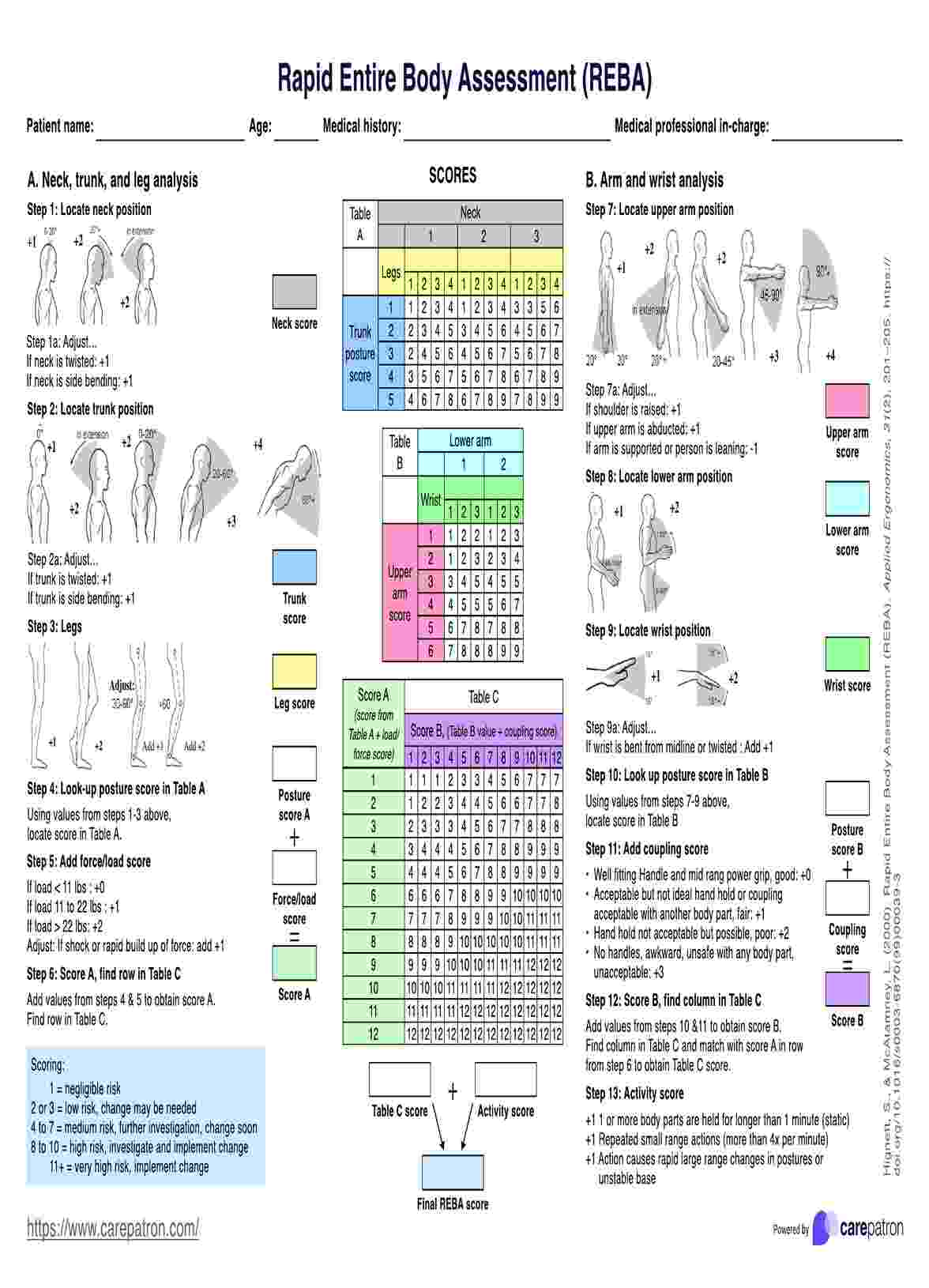
REBA evaluates your workers’ postures across two primary body groupings. Group A covers trunk, neck, and legs—critical for tasks involving lifting, bending, or sustained standing. Group B addresses arms, forearms, and wrists, essential for assembly, packaging, or computer work. Each segment receives points based on deviation from neutral positioning.
For the trunk assessment, a worker maintaining a neutral spine scores minimally, while extreme flexion beyond 60 degrees or sustained twisting dramatically increases the score. Neck assessment follows similar principles, with neutral positioning scoring lowest and extreme rotation generating higher risk values. Leg scoring considers weight distribution—whether the worker stands balanced, walks during the task, or adopts high-risk positions like squatting or kneeling.
Upper limb assessment focuses on arm elevation relative to the body. Arms working naturally at waist level generate lower scores than shoulders elevated above 45 degrees or sustained overhead work. Wrist assessment accounts for deviation from neutral positioning, with extreme flexion or extension significantly increasing risk levels.
Translating Scores into Urgent Workplace Actions
Once segment scores combine into Group A and Group B totals, the REBA action table converts these numbers into five clear intervention levels:
- Action Level 1 (Score: 1): Negligible risk requiring no specific action beyond general ergonomic awareness
- Action Level 2 (Scores: 2-3): Low risk where improvements may be beneficial but aren’t urgent
- Action Level 3 (Scores: 4-7): Medium risk requiring investigation and changes within 3 months
- Action Level 4 (Scores: 8-10): High risk demanding prompt investigation and implementation
- Action Level 5 (Scores: 11-15): Very high risk requiring immediate task modification
This structured approach eliminates guesswork about where to focus limited improvement resources. When you assess multiple workstations, the scoring system instantly highlights which positions need urgent attention versus those where changes can be phased in over time.
Conducting Your First REBA Assessment: A Practical Walkthrough
Implementing REBA in your workplace requires systematic observation but quickly becomes second nature with practice. Follow these steps to ensure accurate, actionable results during your assessment.
Capturing True Task Demands Through Strategic Observation
Before scoring begins, observe the complete work cycle multiple times to identify worst-case postures. Note environmental constraints like space limitations or equipment design features that force awkward positions. For complex movements, video recording enables frame-by-frame analysis and provides documentation for tracking improvement effectiveness after changes are implemented.
Critical to accurate assessment is defining the specific task phase being evaluated. REBA scores individual postures or movement patterns, so clearly identifying whether you’re assessing the lifting phase, placement phase, or transition between positions prevents inconsistent scoring. For tasks with multiple distinct postures, score each critical phase separately.
Step-by-Step Segment Scoring Without Missing Key Risk Factors
Begin with Group A scoring. For the trunk assessment, determine whether the worker maintains neutral positioning or deviates into flexion, extension, or lateral bending. A worker repeatedly bending forward to access floor-level materials scores differently than one maintaining upright posture at a properly adjusted workstation.
Neck positioning follows similar principles—neutral head alignment scores minimally while extreme rotation during overhead work or looking down at materials generates higher scores. For leg assessment, determine if the worker stands balanced, walks during the task, or adopts high-risk positions like single-leg stance or kneeling.
For Group B, focus on arm positioning relative to the body. Arms working between waist and shoulder height generate lower scores than arms abducted away from the body or elevated overhead. Forearm and wrist assessment considers deviation from neutral positioning, with extreme angles significantly increasing risk scores.
Accounting for Real-World Factors That Amplify Risk
After establishing initial posture scores, adjust for coupling quality—the effectiveness of the worker’s grip on materials. Good coupling through well-designed handles minimally increases scores, while poor coupling with irregular objects or hazardous surfaces substantially elevates risk levels.
Force or load magnitude also impacts final scoring. Negligible forces receive no additional points, while occasional forces between 5-10 kilograms add moderate increases, and frequent forces exceeding 10 kilograms generate significant score elevation. Accurately estimating force requires considering material weight, distance from the body, and movement velocity.
Where REBA Delivers Maximum Value Across Industries
REBA proves particularly valuable in environments where workers adopt varied postures throughout their shifts. In manufacturing settings, it effectively evaluates assembly tasks where workers bend, twist, and reach during component installation. The tool’s holistic approach captures risk from combined movements that isolated assessments would miss.
Healthcare facilities rely heavily on REBA for patient handling activities. Nurses performing transfers or repositioning benefit from REBA’s ability to quantify risk from combined trunk bending, arm elevation, and awkward grips during patient care. Many healthcare organizations now mandate REBA assessments before implementing new patient handling protocols.
Warehouse operations gain significant insights from REBA assessments of picking, packing, and loading tasks. The dynamic nature of material handling, where workers move between different postures, makes REBA’s comprehensive body evaluation particularly appropriate. Office environments also benefit when assessing tasks involving prolonged sitting with poor monitor positioning or archival work requiring frequent bending and reaching.
Avoiding Common REBA Implementation Mistakes
Many organizations undermine REBA’s effectiveness through preventable errors during implementation. The most frequent mistake involves conducting assessments without proper training—evaluators who haven’t practiced distinguishing between 20-degree versus 60-degree trunk flexion generate inconsistent scores that compromise program credibility.
Another common error is treating REBA as a one-time compliance exercise rather than an ongoing improvement process. Effective programs establish regular reassessment schedules to track improvement effectiveness after interventions and adapt to process changes. Documentation should capture not just final scores but the specific postures driving high-risk contributions, providing clear direction for targeted improvements.
Successful implementation requires worker involvement throughout the process. Frontline employees understand task realities that observers may miss, and their participation in solution development dramatically improves adoption of ergonomic improvements. Many leading organizations train workers to conduct basic REBA self-assessments, expanding assessment capacity while building ergonomic awareness across the workforce.
Transforming REBA Scores into Lasting Workplace Improvements
The true value of REBA emerges when assessment results drive meaningful changes. Start by prioritizing interventions based on action levels—addressing Action Level 4 and 5 scores immediately while developing phased plans for lower-risk positions. Focus improvement efforts on the specific body segments generating highest scores rather than implementing generic “ergonomic fixes.”
Document improvement effectiveness through repeat assessments after changes are implemented. This creates objective evidence of program value that helps secure ongoing leadership support. Track injury rates, workers’ compensation claims, and productivity metrics alongside REBA scores to demonstrate the business impact of ergonomic improvements.
Integrate REBA into broader safety management systems rather than treating it as a standalone tool. Connect assessment results with job hazard analyses, incident investigations, and new workstation design processes. This systems approach ensures ergonomic considerations become embedded in operational decision-making rather than treated as an afterthought.
REBA assessments work best when combined with engineering controls, administrative adjustments, and organizational culture supporting ergonomic awareness. When workers understand how to recognize and report risky postures, and when leadership demonstrates genuine commitment to addressing concerns, REBA becomes part of a continuous improvement cycle that sustains long-term benefits.
By implementing REBA systematically across your organization, you’ll transform ergonomic assessment from a compliance exercise into a strategic advantage that protects your most valuable asset—your workforce—while improving productivity and reducing costs associated with musculoskeletal injuries.