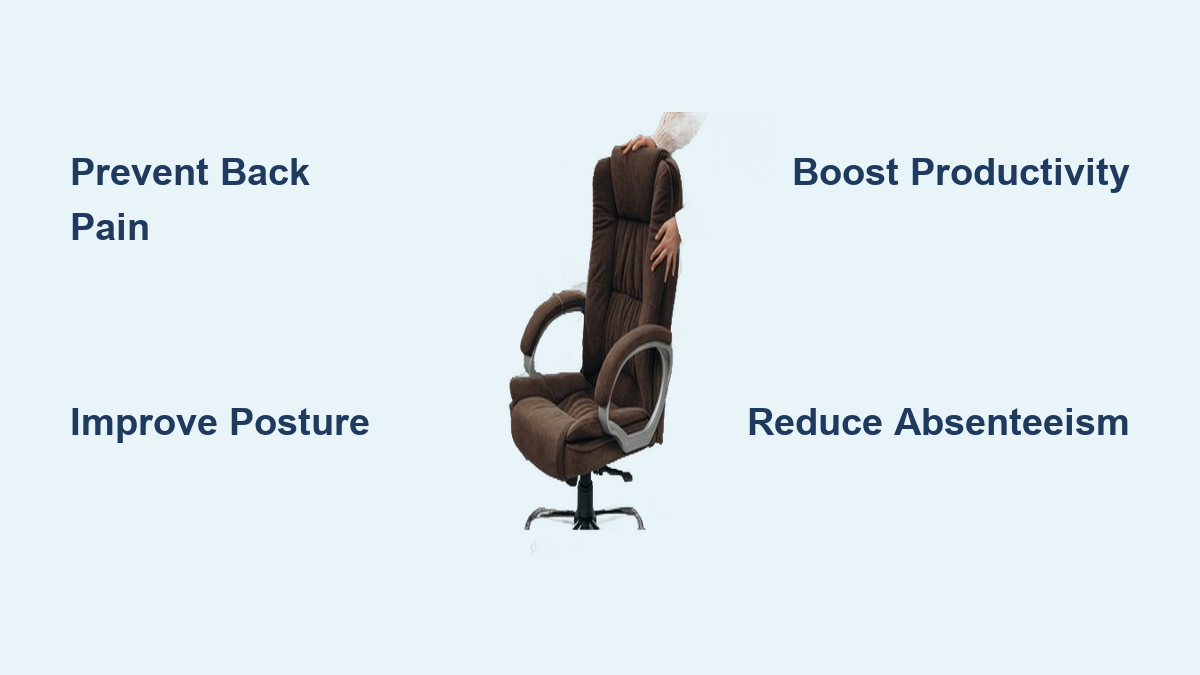
Office workers spend an average of eight hours or more each day seated at their workstations, making the relationship between furniture and wellbeing critically important to both individual health and organizational success. Millions of employees continue to struggle with uncomfortable chairs, poorly positioned desks, and equipment that ignores natural human movement patterns, creating silent health threats that accumulate over time. The benefits of ergonomic office furniture extend far beyond momentary comfort—they address fundamental health risks while delivering measurable productivity gains that transform workplace outcomes. Understanding these comprehensive advantages empowers both employers and employees to make informed decisions about workspace investments that pay dividends across every dimension of work life.
Research demonstrates that organizations implementing comprehensive ergonomic programs experience remarkable improvements in employee health and performance metrics. Studies show ergonomic interventions can increase productivity by an average of eleven percent while reducing employee sick days by thirty-two percent. These aren’t marginal improvements—they represent fundamental transformations in how workers experience their jobs and how organizations benefit from their workforce investments. Whether you’re an employer evaluating procurement decisions or an individual seeking relief from chronic work-related discomfort, the evidence supporting ergonomic office furniture is compelling and multifaceted.
Prevent Musculoskeletal Disorders Effectively

Traditional office furniture forces employees into positions that compress the spine, strain the neck, and place excessive pressure on wrists during repetitive tasks. These strain patterns develop silently over months and years, gradually transforming into chronic conditions that become increasingly difficult to treat. Ergonomic office furniture directly counters these risks by providing adjustable features that accommodate individual body dimensions, creating workstation configurations that support rather than stress the human body.
Quality ergonomic chairs with adjustable lumbar support play a crucial role in preventing lower back pain—the most common complaint among office workers. This support maintains proper spinal alignment even as workers become fatigued during lengthy sessions. Multiple adjustment options—height control, armrest positioning, backrest angle, and headrest customization—allow each user to fine-tune their seating position for optimal spinal alignment that prevents the slouching tendencies leading to chronic discomfort.
Ergonomic keyboards and mice maintain wrists in neutral, natural positions that eliminate angular stress responsible for debilitating conditions like carpal tunnel syndrome and tendonitis. Similarly, properly positioned monitors at eye level prevent the neck flexion that leads to chronic strain and reduced range of motion. These targeted interventions address the root causes of musculoskeletal disorders before they develop into serious health issues.
Improve Posture and Spinal Alignment
Ergonomic chairs provide structural support that physically prevents the slouching tendencies developing when workers become fatigued. Unlike conventional chairs that allow the body to collapse into uncomfortable positions, quality ergonomic seating actively supports the spine’s natural curves, maintaining alignment even when workers lose conscious awareness of their positioning. This automatic posture support proves essential because employees, focused on tasks, quickly lose awareness of their body positioning.
The adjustability of ergonomic workstations enables users to configure their entire setup—desk height, monitor position, keyboard placement, and chair settings—to create a configuration that naturally promotes correct posture without requiring constant conscious effort. When ergonomic furniture handles the mechanics of proper alignment, workers can dedicate their attention to responsibilities rather than monitoring and correcting posture throughout the day.
Proper spinal alignment facilitated by ergonomic furniture prevents uneven wear and tear on joints and vertebrae that leads to chronic pain conditions later in life. Workers who utilize properly configured ergonomic equipment report significant reductions in neck pain, shoulder tension, and lower back discomfort they had previously accepted as normal consequences of office work.
Enhance Circulation and Reduce Daily Fatigue
Prolonged sitting in conventional chairs impairs circulation throughout the lower body, contributing to fatigue, swelling, and potential long-term vascular concerns. Ergonomic furniture, particularly sit-stand desks and chairs designed to encourage movement, actively combats these circulation problems by enabling positional variation throughout the workday. Alternating between sitting and standing positions engages different muscle groups and prevents blood pooling during extended sitting sessions.
Sit-stand desks allow workers to seamlessly transition between positions, promoting better posture, reducing back pain, and improving circulation. Both electric and manual options are available, with electric models offering smoother height transitions and programmable memory functions. This flexibility addresses sedentary behavior concerns increasingly recognized as significant health risks for office workers.
The anti-fatigue benefits of ergonomic furniture manifest through both physical and cognitive channels. Physically, reduced muscle strain means workers experience less fatigue by day’s end. Cognitively, the reduction in physical discomfort leaves more mental bandwidth available for focused work rather than constant low-level processing of pain signals.
Boost Workplace Productivity Significantly

The connection between ergonomic furniture and productivity begins with eliminating physical distractions that fragment attention and reduce cognitive performance. When employees experience chronic discomfort from inadequate seating or improper monitor positioning, a portion of their mental resources remains constantly occupied with managing this discomfort. This cognitive taxation reduces available attention for actual work tasks, creating a hidden productivity drain most organizations never measure.
Research demonstrates that implementing ergonomic office designs enhances productivity by aligning workspace configuration with natural human movements. The state of flow—the psychological state of complete absorption in a task—becomes more accessible when workers aren’t constantly adjusting their position seeking relief. Studies showing an eleven percent average productivity increase following ergonomic interventions represent substantial improvements that compound across an entire workforce.
Workers who complete tasks more quickly and with higher quality generate more value without requiring proportional increases in labor costs. The ability to work with less pain and handle workloads with greater ease translates directly into faster task completion and improved output quality that benefits organizational bottom lines.
Reduce Absenteeism and Presenteeism Costs
The financial impact of ergonomic furniture investment becomes particularly apparent when examining absence patterns. Work-related injuries and chronic pain conditions lead to significant numbers of sick days annually, with conventional workstations contributing to musculoskeletal problems. Ergonomic furniture directly addresses these root causes, reducing frequency and severity of workplace injuries. Organizations with comprehensive ergonomic programs report a thirty-two percent reduction in employee sick days.
Presenteeism—the phenomenon of employees coming to work but functioning at reduced capacity due to health concerns—represents an even larger productivity drain than absenteeism. Employees experiencing back pain or repetitive strain symptoms may be physically present but their output quality suffers significantly. Ergonomic furniture reduces these health issues, ensuring the workforce operates at full capacity during all working hours.
The combination of reduced absenteeism and eliminated presenteeism creates a productivity multiplier that quickly justifies ergonomic furniture investment. When workers are both present and fully functional, organizational capacity increases without corresponding increases in headcount or labor costs.
Select Essential Ergonomic Furniture Types
The cornerstone of any ergonomic workspace is a properly configured office chair featuring multiple adjustment capabilities. Quality ergonomic chairs provide height adjustment allowing feet flat on the floor with knees at ninety-degree angles, lumbar support maintaining the spine’s natural curve, and adjustable armrests supporting forearms without raising shoulders. Additional features like swivel functionality, breathable mesh materials, and headrest options enhance comfort during extended work sessions.
Sit-stand desks have become essential components of ergonomic workspace design. These desks allow employees to alternate between sitting and standing positions, promoting better posture and improved circulation. Electric models offer smoother height transitions and programmable memory functions, while anti-fatigue mats improve comfort during standing periods.
A comprehensive ergonomic workspace includes accessories addressing specific strain points. Ergonomic keyboards and mice maintain natural wrist positions preventing repetitive strain injuries. Wrist rests provide additional support during typing sessions, while monitor arms elevate screens to eye level, preventing neck strain during extended computer work.
Calculate Return on Investment
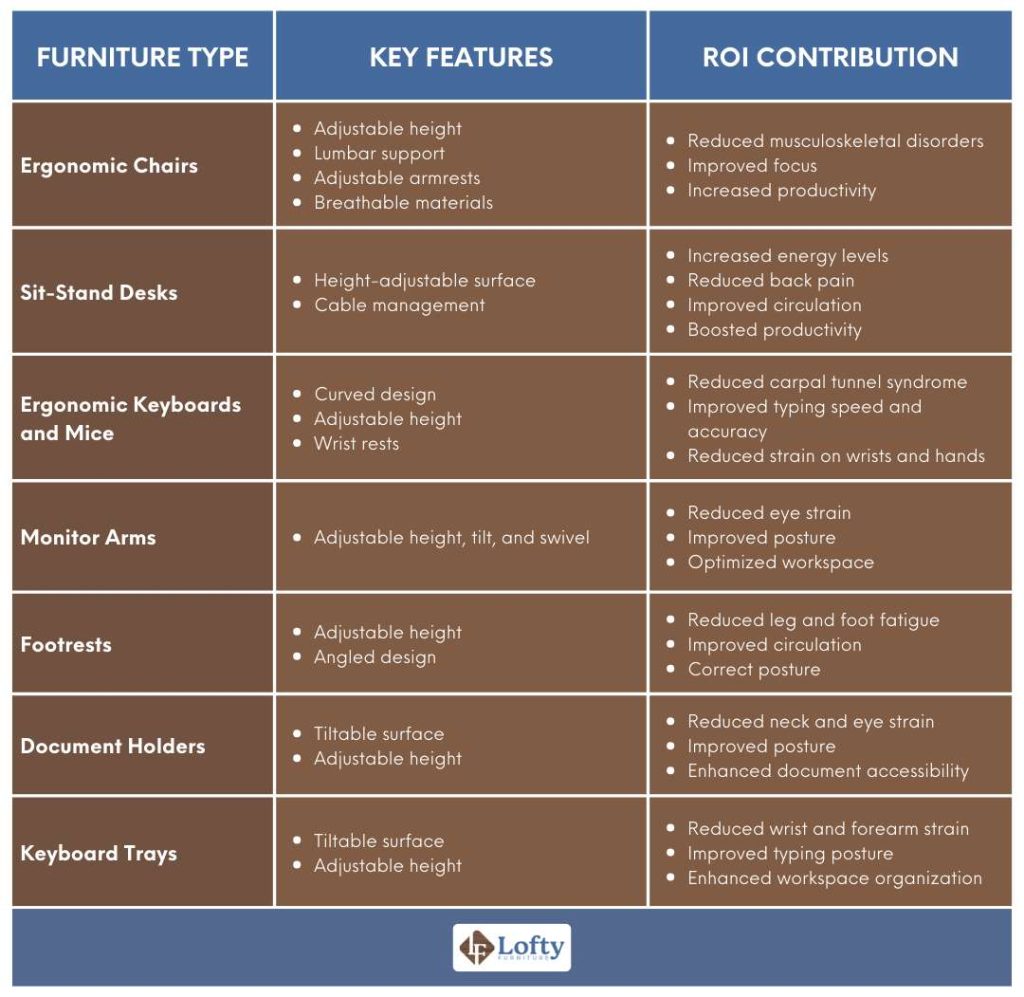
While ergonomic office furniture carries higher upfront costs than conventional alternatives, the long-term financial benefits substantially outweigh these initial investments. Organizations should approach ergonomic furniture procurement as capital investments rather than operating expenses, recognizing that quality ergonomic furniture delivers returns throughout its extended useful life.
Research provides quantified estimates of productivity and health improvements associated with ergonomic interventions. The eleven percent productivity increase and thirty-two percent reduction in sick days represent substantial financial improvements that compound across an entire workforce. Direct healthcare cost reductions—fewer workers’ compensation claims and reduced treatment spending—typically recover furniture investments within relatively short timeframes.
The indirect financial benefits prove even more substantial over extended time horizons. Reduced absenteeism means fewer days of lost productivity covered through overtime or temporary staffing. Enhanced employee retention reduces recruitment and training expenses. The combination of these factors creates a compelling return on investment case demonstrating the financial wisdom of ergonomic furniture procurement.
Implement Ergonomic Solutions Successfully
Successful ergonomic furniture implementation begins with thorough assessment of existing workspace configurations and employee needs. Organizations should evaluate current furniture arrangements, consult directly with workers, and develop comprehensive strategies addressing identified issues through furniture replacement or modification. Individual consultations surface specific discomforts that may not be apparent to management observers.
Customization represents a critical success factor in ergonomic furniture implementation. Organizations should select furniture with sufficient adjustment ranges to accommodate workforce diversity and allocate resources for proper workstation configuration. Simply purchasing ergonomic furniture without appropriate setup significantly diminishes the benefits these products can deliver.
Even the most sophisticated ergonomic furniture cannot fully counteract health risks of extended sedentary behavior. Organizations should integrate movement protocols encouraging workers to change positions and stretch throughout the day. Recommendations suggest getting up and moving around every thirty minutes. This movement integration complements ergonomic furniture benefits, creating multiplicative advantages that exceed what either intervention could achieve independently.
Final Note: Investing in ergonomic office furniture delivers measurable returns across health, productivity, and financial metrics. By preventing musculoskeletal disorders, improving posture, enhancing circulation, and boosting productivity, these strategic workspace investments create healthier, happier, and more effective work environments. Whether you’re an employer evaluating procurement decisions or an employee seeking relief, understanding the comprehensive benefits of ergonomic office furniture empowers you to make informed choices that transform workplace experiences and outcomes.
Leave a Reply