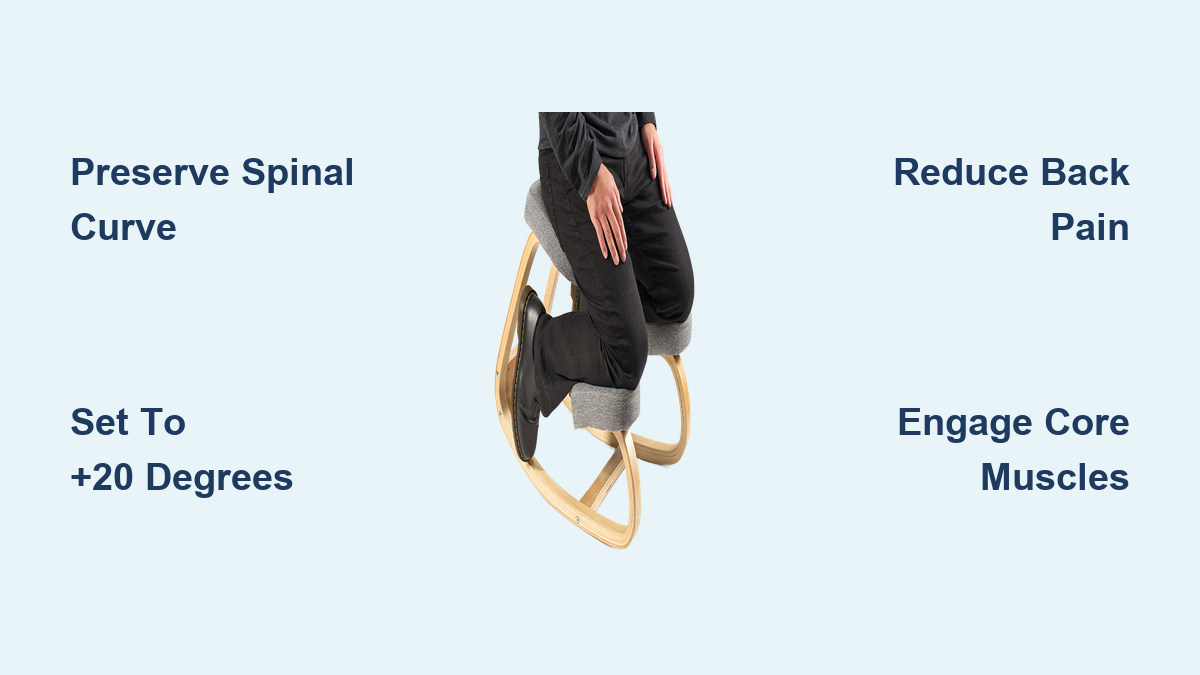
If you’ve ever felt that familiar ache creeping up your lower back after hours at your desk, you’re not alone. Millions of office workers struggle with back discomfort caused by conventional seating that forces the spine into unnatural positions. Traditional office chairs, despite their padded seats and adjustable features, often fail to maintain the lumbar curve essential for spinal health. Understanding the ergonomic kneeling chair benefits can completely change your workday experience. These innovative seating solutions work with your body’s natural alignment rather than against it, offering scientifically validated advantages that go far beyond momentary comfort.
Research now confirms what many ergonomic specialists have long suspected: the way we sit directly impacts our spinal health over time. By shifting to a kneeling chair configured at +20 degrees, you can preserve your natural lumbar curvature significantly better than with standard office seating. This article reveals the specific, measurable advantages documented in scientific studies and provides practical guidance for implementing this seating solution in your daily routine.
How Kneeling Chairs Preserve 7.6 Degrees of Natural Spinal Alignment

The most compelling evidence supporting ergonomic kneeling chair benefits comes from objective measurements of spinal alignment. A rigorous scientific study using the Middlesbrough Integrated Assessment System (MIDAS) revealed that ergonomically designed kneeling chairs set at +20 degrees inclination preserve standing lumbar curvature significantly better than standard computer chairs—with a measurable 7.633-degree advantage. This isn’t just a theoretical improvement; it represents a clinically meaningful difference in how your spine maintains its natural shock-absorbing curve during seated work.
Researchers tested twenty participants aged 18-35 using a repeated measures design where each person served as their own control across three positions: standing (the ideal reference), sitting on a standard office chair, and sitting on a properly configured kneeling chair. The statistical analysis confirmed these findings with p < 0.05 significance, proving the difference wasn’t due to chance. While both seating options created some deviation from standing posture, the kneeling chair reduced this deviation by more than seven degrees on average—translating to substantially less strain on your spinal structures throughout the workday.
Configure Your Chair to +20 Degrees for Maximum Postural Benefit
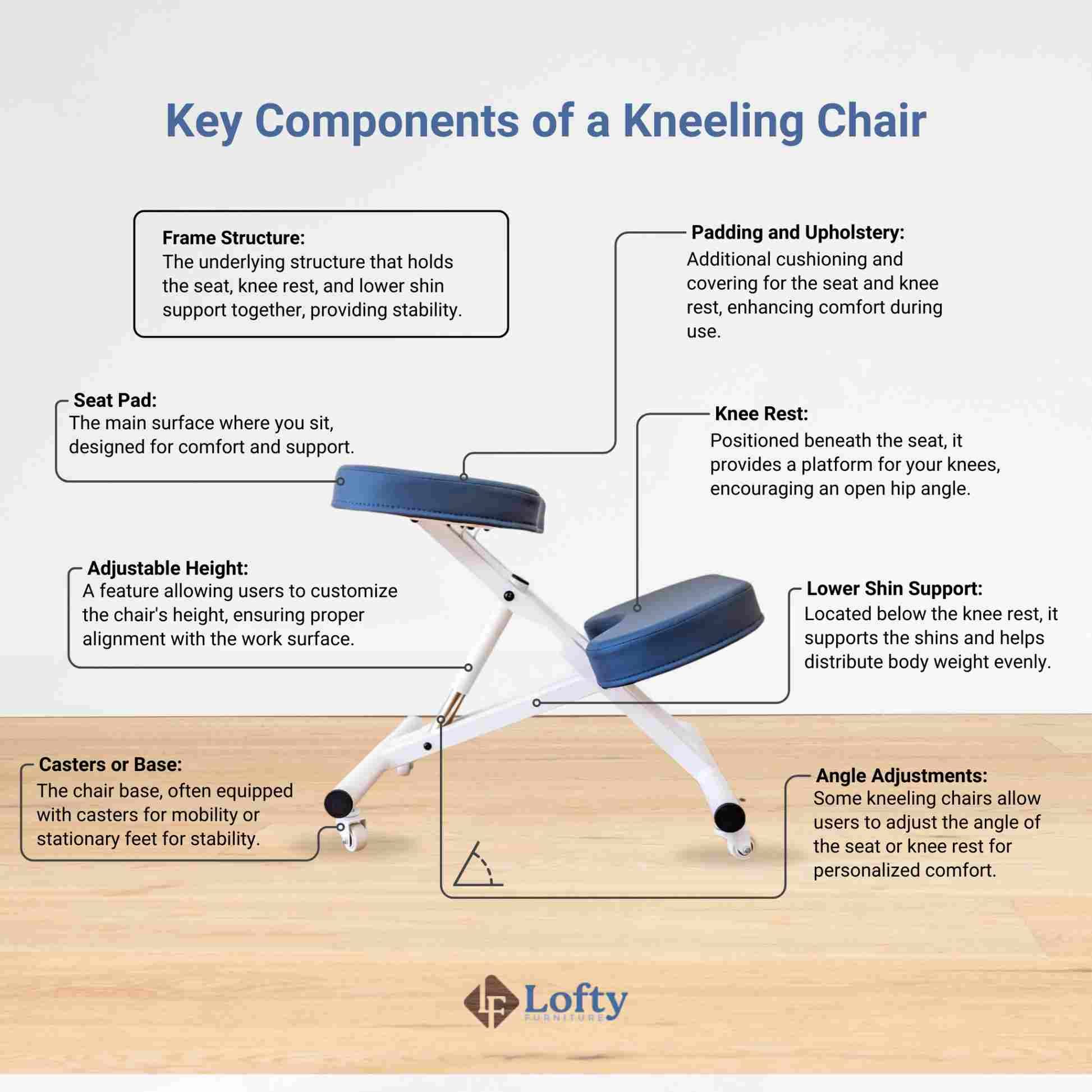
Not all kneeling chair angles deliver equal results—scientific research identifies +20 degrees of inclination as the precise configuration that maximizes spinal benefits. This specific angle creates the optimal balance where your weight distributes appropriately between your shins and seat while maintaining the open hip position crucial for preserving natural lumbar curvature. When properly configured to this specification, your pelvis tilts forward into an anterior position that actively restores the lumbar curve flattened by conventional seating.
Many users unknowingly miss out on the full ergonomic kneeling chair benefits because they fail to adjust their chairs to this scientifically validated angle. Chairs without adjustable inclinations or those set to significantly different angles may provide comfort but deliver reduced postural advantages. Take just two minutes to verify your chair’s configuration—this simple adjustment transforms your seating from merely comfortable to genuinely therapeutic for your spine.
Stop Back Pain Before It Starts with Proper Seating Alignment
The connection between poor seating posture and low back pain has reached near-consensus among healthcare professionals. Research consistently shows that conventional seating, with its posterior pelvic tilt and flattened lumbar curve, creates conditions that predispose users to chronic back problems. Ergonomic kneeling chairs directly address this issue through their fundamental design philosophy, which prioritizes maintaining your natural spinal curvature over maximizing cushioning or passive support.
When you sit on a properly configured kneeling chair, your hips open to approximately 135 degrees or greater, keeping hip flexors elongated rather than shortened. This position reduces the psoas muscle’s pull on lumbar vertebrae and creates more uniform loading across intervertebral discs. Unlike subjective comfort claims, these ergonomic kneeling chair benefits are objectively measurable through tools like MIDAS, eliminating placebo effects as an explanation for the documented improvements in spinal alignment.
Why Inclined Seating Works With Your Body’s Natural Mechanics
Understanding the science behind kneeling chairs reveals why they outperform conventional seating. When standing in optimal posture, your spine maintains a gentle S-shaped curve that efficiently distributes mechanical loads. Traditional seating disrupts this natural configuration by bending your hips, causing posterior pelvic rotation that flattens your lumbar lordosis into a C-shape. This concentrates stress on the front portions of your intervertebral discs—a position your spine wasn’t designed to maintain for hours daily.
The kneeling chair’s forward-angled seat actively counters this problem by encouraging anterior pelvic rotation. This restoration of lumbar lordosis re-establishes your spine’s optimal loading patterns while the knee support prevents forward sliding. The result? Your spine maintains its natural shock-absorbing curve even during extended work sessions, reducing the cumulative strain that leads to many common back problems over time.
Engage Your Core Muscles for Active Sitting Benefits

One of the most significant yet overlooked ergonomic kneeling chair benefits involves the muscular activity these chairs promote. Unlike conventional chairs that allow passive “collapsing” into the seatback, kneeling chairs require active engagement of your core stabilizers to maintain upright posture. This low-level muscular activity provides continuous blood flow to supporting tissues, preventing the stiffness and deconditioning that often accompany prolonged passive sitting.
While this active sitting may feel more demanding initially—especially if you’re accustomed to fully reclined positions—this engagement serves crucial long-term functions. The sustained muscle activity provides ongoing sensory feedback about your spinal position, helping you maintain awareness rather than gradually slumping throughout the day. Over weeks of consistent use, this pattern builds stronger core musculature and improves your natural postural awareness, reducing dependence on external support for comfortable spinal alignment.
Long-Term Spinal Protection for Desk Workers
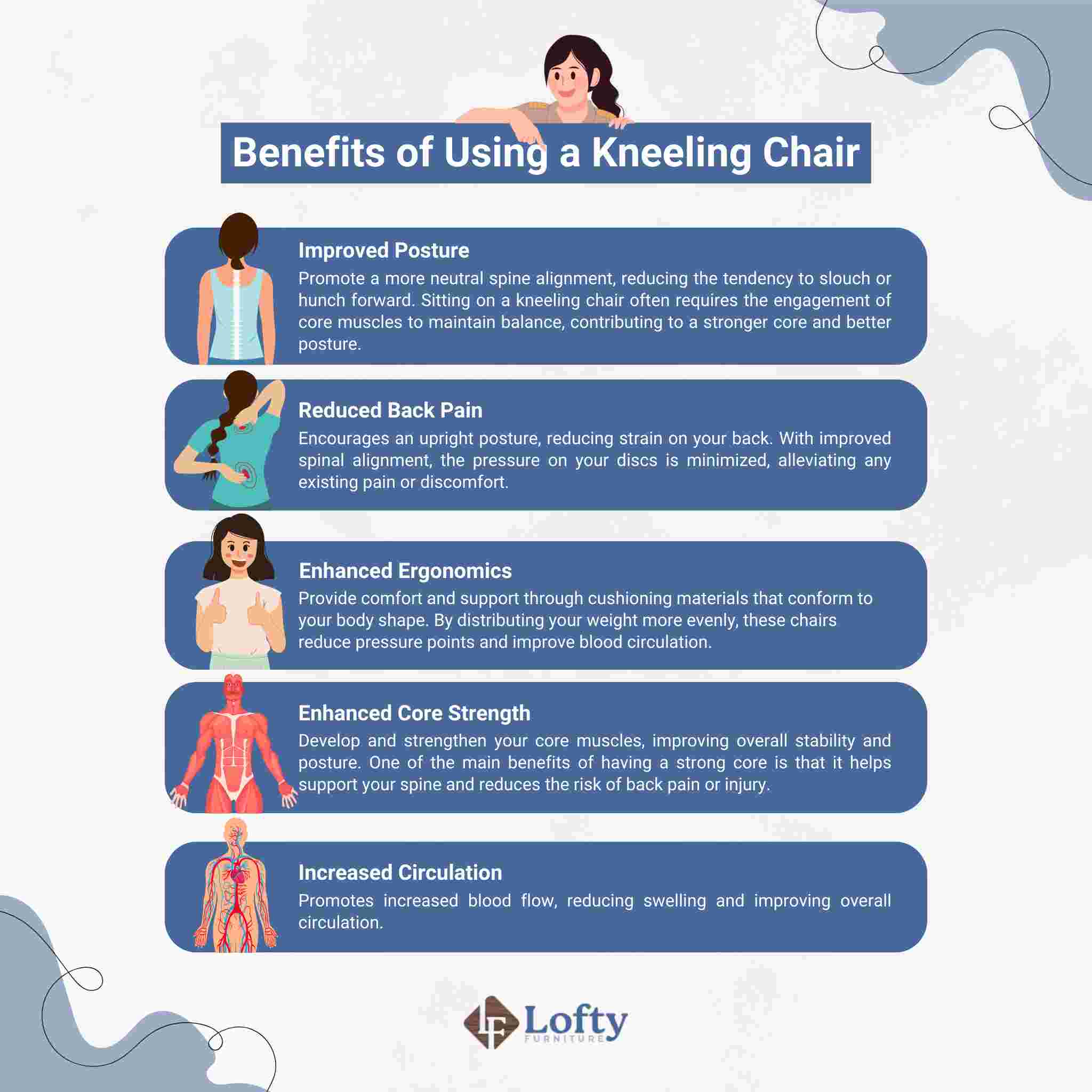
The immediate postural benefits of kneeling chairs become even more valuable when considering their long-term impact. For office workers spending 2,080 hours annually in seated positions, the seven-degree improvement in lumbar curvature preservation translates to substantially reduced cumulative spinal stress. Over a decade of daily use, this difference could mean thousands of hours less abnormal loading on your spinal structures.
Consider that conventional seating typically creates approximately 15 degrees of deviation from optimal standing posture, while properly configured kneeling chairs reduce this to about 7 degrees. This seemingly small difference compounds significantly over years of daily use, potentially delaying disc degeneration, reducing muscular fatigue, and lowering your risk of developing chronic low back conditions. For younger workers establishing lifelong habits, the ergonomic kneeling chair benefits may pay dividends in mobility and comfort decades later.
Reduce Pressure Points Through Smart Weight Distribution
Beyond spinal alignment, kneeling chairs offer practical advantages through superior weight distribution. Traditional chairs concentrate pressure on your ischial tuberosities (sit bones), creating numbness and discomfort that prompt constant position shifting. The dual-contact design of kneeling chairs—weight distributed between shins and seat—spreads pressure across a larger surface area, reducing peak pressures at any single point.
This broader weight distribution prevents the restricted blood flow that causes “pins and needles” sensations during prolonged sitting. The inclined position also naturally encourages subtle movements that further promote circulation. Additionally, the forward tilt reduces pressure on your lumbar spine by changing your torso orientation relative to your pelvis, decreasing mechanical demands on spinal structures during sustained sitting sessions.
Smooth Transition Strategies for New Kneeling Chair Users
Adapting to a kneeling chair requires a thoughtful approach to maximize benefits while minimizing initial discomfort. Most users experience an adjustment period of two to three weeks as core, thigh, and shin muscles adapt to new demands. This initial fatigue represents beneficial muscular conditioning rather than harmful strain—you’re building the endurance needed for healthier sitting.
Start with shorter sessions of 20-30 minutes, gradually increasing duration as your body adapts. Take brief standing breaks every 30-45 minutes during this transition period to manage muscular fatigue. If shin discomfort persists beyond the initial adaptation phase, verify your chair is properly configured to the +20 degree specification—incorrect angles can concentrate pressure uncomfortably rather than distributing it appropriately.
Who Gains the Most From Kneeling Chair Advantages
While most desk workers benefit from ergonomic kneeling chairs, certain individuals experience particularly pronounced improvements. Those already experiencing low back discomfort often report meaningful relief as the restored lumbar curvature addresses positional factors contributing to their symptoms. Young adults establishing lifelong seating habits represent another high-benefit group, as investing in spinal health during these formative years may yield decades of cumulative advantages.
Knowledge workers requiring sustained concentration may find additional value in how the active sitting position promotes mental alertness. The low-level muscular engagement and upright torso orientation both contribute to a state of wakeful readiness that passive sitting can undermine. Many users report feeling more mentally focused when working from properly configured kneeling chairs compared to conventional seating options.
Maximize Your Investment With Proper Configuration
To fully realize the documented ergonomic kneeling chair benefits, proper configuration and consistent use are essential. Set your chair to the scientifically validated +20 degree inclination as your baseline, then fine-tune based on your individual proportions. Chairs with multiple angle settings allow customization to your specific leg length and torso height, optimizing the biomechanical advantages for your unique body.
Consistency matters significantly—intermittent use between kneeling and conventional chairs prevents the muscular conditioning needed for long-term benefits. Plan to use your kneeling chair for the majority of seated work sessions, reserving conventional seating only for temporary needs during your adaptation period. Combine kneeling chair use with periodic standing breaks for an ideal spinal health regimen: 20-30 minutes of active sitting followed by brief standing or walking intervals throughout your workday.
Make Evidence-Based Seating Decisions for Long-Term Health
The research compiled here provides credible, scientifically validated support for ergonomic kneeling chair benefits that extend beyond marketing claims. The 7.633-degree improvement in lumbar curvature preservation, statistically significant differences from standard chairs, and logical biomechanical mechanisms collectively establish kneeling chairs as legitimate ergonomic interventions for protecting spinal health.
While individual responses vary based on body proportions and existing conditions, the evidence suggests genuine advantages for most users. Rather than viewing this as a temporary fix, consider it an investment in your long-term spinal wellness. For healthy individuals seeking to optimize their seated work environment, the documented benefits of properly configured ergonomic kneeling chairs represent a compelling, evidence-based solution to the pervasive problem of work-related back discomfort. By aligning your seating with your body’s natural design, you’re not just addressing current discomfort—you’re actively protecting your spinal health for years to come.
Leave a Reply