Manufacturing professionals know that ergonomics isn’t just about worker comfort—it directly impacts productivity, quality, and bottom-line results. Yet too many presentations on ergonomics in manufacturing industry PPT formats fail to engage audiences or drive meaningful change. Statistics show that poorly designed slides contribute to 68% of failed ergonomics initiative rollouts, as critical information gets lost in text-heavy decks that fail to connect with production managers, safety teams, and executives. Your manufacturing ergonomics presentation must bridge the gap between technical risk factors and business outcomes to secure the buy-in needed for successful implementation.
This guide delivers actionable strategies specifically for creating compelling ergonomics in manufacturing industry PowerPoint presentations that resonate with diverse stakeholders. You’ll learn how to transform complex ergonomic principles into visually engaging slides that clearly demonstrate return on investment, address specific manufacturing pain points, and motivate action across all organizational levels. Whether you’re developing training materials for frontline workers or pitching an ergonomics program to executives, these proven techniques will ensure your presentation drives real change in your manufacturing environment.
Essential Slide Structure for Manufacturing Ergonomics Presentations
The sequence of your ergonomics in manufacturing industry PPT determines whether your message lands effectively. Start with a problem-focused slide showing real manufacturing floor scenarios where ergonomic failures cause injuries or production delays—this immediately creates relevance for your audience. Follow with a concise “cost of inaction” slide featuring industry-specific statistics: 1.8 million annual MSD injuries in manufacturing with 600,000 requiring medical treatment translates to significant financial impact your audience can’t ignore.
The Critical First 3 Slides That Determine Success
Your opening trio must establish credibility, relevance, and urgency within 90 seconds. Begin with a high-impact photo of your actual manufacturing environment showing both proper and improper ergonomic practices side-by-side. The second slide should present a customized ROI calculation showing potential savings specific to your facility’s size and production volume. Third, include a brief testimonial from a respected production supervisor who implemented ergonomic improvements—this social proof builds immediate trust with your manufacturing audience.
How to Sequence Risk Factors for Maximum Engagement
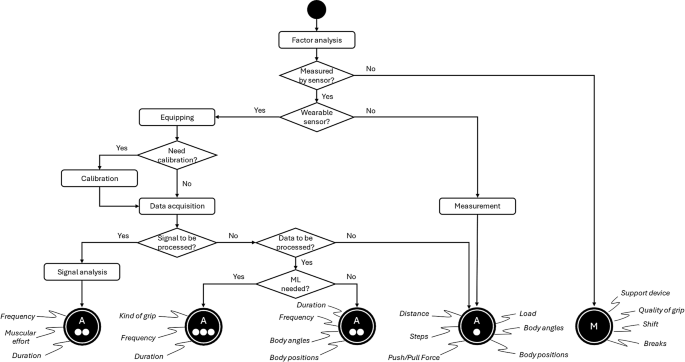
Rather than listing the five primary ergonomic risk factors (repetition, forceful exertion, awkward posture, contact stress, vibration) in isolation, sequence them as interconnected challenges that compound each other on the manufacturing floor. Create a visual flowchart showing how repetitive motions combined with awkward postures during assembly tasks create cumulative risk that exceeds individual factors. Add facility-specific examples like “This welding station exposes workers to both vibration and awkward postures simultaneously, increasing MSD risk by 73% compared to single-factor exposure.”
Transforming Technical Data into Compelling Visuals

Manufacturing professionals respond best to visuals that mirror their daily reality. Convert abstract ergonomic concepts into relatable manufacturing imagery—show a before-and-after comparison of an assembly line workstation with clear annotations highlighting specific improvements. Replace generic anatomical diagrams with photos overlaid on actual workstations showing pressure points, joint angles, and movement patterns relevant to your specific manufacturing processes.
Converting MSD Statistics into Memorable Infographics
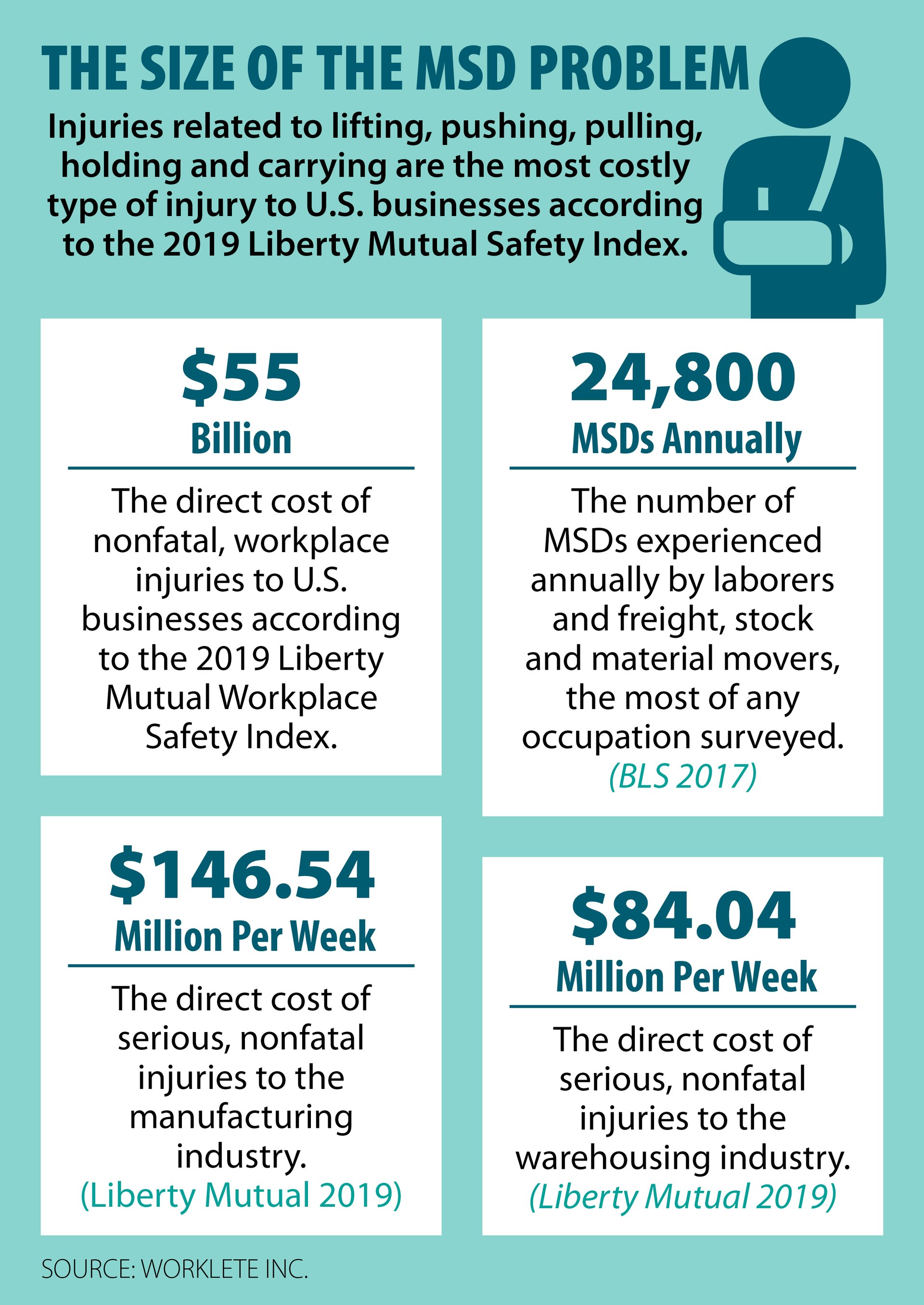
Transform the statistic that 600,000 manufacturing MSD injuries require medical treatment annually into a powerful visual: display 600,000 tiny worker icons filling your facility’s floor plan to scale. For executive presentations, create a financial impact visual showing how ergonomics improvements reduce costs across multiple categories—workers’ compensation (down 42%), turnover (reduced by 31%), quality defects (decreased 27%)—with arrows connecting to your facility’s actual financial metrics.
Before-and-After Visuals That Demonstrate Real Impact
Include side-by-side photos of actual workstation modifications in your facility with measurable results. Show the old workstation where operators bent forward at 60 degrees during assembly, then the modified version with adjustable height tables allowing neutral postures. Overlay text with concrete outcomes: “Reduced lower back complaints by 68% and increased assembly speed by 12 seconds per unit.” These facility-specific visuals make the benefits tangible and impossible to dismiss.
Key Content Areas Every Manufacturing Ergonomics PPT Must Include
Your ergonomics in manufacturing industry PowerPoint must address both safety concerns and production realities. Include a dedicated slide showing how ergonomic improvements directly impact key manufacturing metrics like Overall Equipment Effectiveness (OEE), First Pass Yield, and changeover times. Production managers respond to data they already track—demonstrate how reducing fatigue-related errors improves quality rates and reduces rework.
The 5 Risk Factors Slide That Resonates with Production Managers
Create a manufacturing-specific risk factors matrix with columns for “Typical Manufacturing Task,” “Observed Risk Factor,” “Current Impact on Production,” and “Practical Mitigation.” For vibration exposure, list “Handheld grinding operations” in the task column, then show how it causes “grip strength reduction after 2 hours” impacting production, with the solution being “anti-vibration tool mounts that maintain throughput while reducing risk.” This connects ergonomic concerns directly to production outcomes managers care about.
ROI Calculations That Get Leadership Buy-In
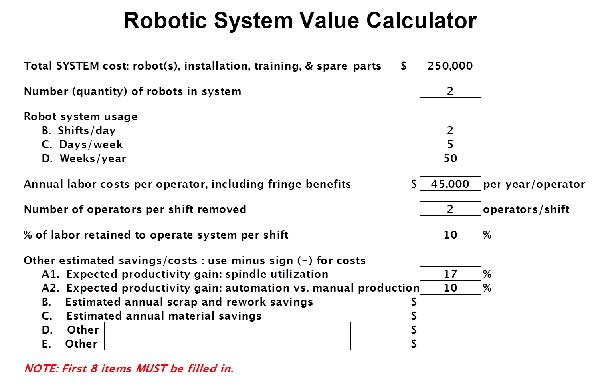
Executives need to see the business case in their language. Develop a slide showing the payback period for ergonomic investments using your facility’s actual data: “For a $15,000 investment in adjustable workstations, we prevent 3 MSD cases annually at $8,500 each, plus gain $12,000 in productivity improvements—achieving ROI in 5.2 months.” Include both direct costs (workers’ comp) and indirect costs (rework, turnover) to present the complete financial picture leadership requires.
Common Manufacturing Ergonomics Presentation Mistakes to Avoid
Many ergonomics in manufacturing industry PowerPoint decks fail by overwhelming audiences with technical jargon and academic concepts disconnected from shop floor realities. Avoid generic statements like “improve workplace ergonomics” and instead specify “reduce shoulder elevation during overhead assembly by installing height-adjustable fixtures at Station 12.” Manufacturing professionals respect concrete, actionable solutions they can implement tomorrow.
Why “Death by Bullet Points” Kills Initiative Support
Text-heavy slides with 8+ bullet points per slide lose audience attention within 30 seconds. Replace lengthy explanations with visual process maps showing the workflow before and after ergonomic interventions. Use minimal text—maximum 20 words per slide—and let powerful images tell the story. For complex procedures, embed short 15-second video clips showing the correct technique rather than describing it in text.
Technical Jargon That Confuses Your Audience
Avoid terms like “anthropometric considerations” or “biomechanical loading” that create barriers to understanding. Instead, use manufacturing-friendly language: “This tool handle redesign reduces grip force by 35%, meaning operators can work longer without hand fatigue.” Translate ergonomic concepts into production terms your audience already understands and values.
Proven Slide Templates for Different Manufacturing Audiences
Tailor your ergonomics in manufacturing industry PowerPoint presentation to your specific audience. For safety committees, emphasize hazard identification techniques with photos of actual facility hotspots. For executives, focus on financial metrics and strategic alignment. For frontline workers, use interactive elements where they identify ergonomic risks in photos of their actual work areas.
Safety Committee Presentation Framework
Structure this presentation around actionable assessment tools they can implement immediately. Include a slide with a simple 5-point ergonomic risk checklist they can use during daily safety walks: 1) Are workers bending forward more than 30 degrees? 2) Are they repeating the same motion more than 10 times per minute? 3) Are they using excessive grip force? 4) Are there hard surfaces pressing against body parts? 5) Are they exposed to vibration? Provide a printable version they can carry on the floor.
Executive Leadership Pitch That Secures Funding
Focus on strategic alignment with business objectives. Create a slide showing how ergonomics improvements support your company’s specific strategic goals—whether that’s quality excellence, operational efficiency, or workforce sustainability. Include a timeline showing phased implementation with quick wins in months 1-3 (low-cost adjustments), mid-term improvements (workstation modifications), and long-term transformation (equipment redesign), each with associated ROI metrics.
Interactive Elements That Boost Training Retention
Static slides create passive audiences—manufacturing ergonomics presentations need engagement to drive behavior change. Embed quick interactive assessments where viewers identify ergonomic risks in photos of actual workstations. Include QR codes linking to 60-second video demonstrations of proper techniques they can scan and watch right on the manufacturing floor.
Digital Tools That Turn Viewers into Active Participants
Integrate simple polling tools where production teams vote on which workstation improvements would have the biggest impact in their area. Display real-time results to build consensus and ownership. For virtual presentations, use annotation features allowing participants to circle problem areas directly on shared workstation images—this transforms passive viewing into active problem-solving.
Creating a high-impact ergonomics in manufacturing industry PowerPoint presentation requires moving beyond generic templates to develop facility-specific, audience-tailored content that speaks the language of each stakeholder group. By focusing on visual storytelling, concrete manufacturing examples, and clear connections between ergonomic improvements and business outcomes, your presentation will drive meaningful action rather than gathering digital dust. Remember that the most effective ergonomics presentations don’t just inform—they inspire immediate next steps, with every slide designed to overcome specific objections and build momentum for implementation. Start with one high-impact workstation modification, document the results thoroughly, and use those real-world successes as the foundation for your next ergonomics in manufacturing industry PPT that will secure even broader support and investment.
Leave a Reply