Best Ergonomic Footrests for Office Chairs in 2026
If your chair is high enough for comfortable desk work but your feet do not rest comfortably on the floor, a footrest can be a much simpler solution than replacing the entire chair. The important question is not whether a footrest is labelled “ergonomic”; it is whether it actually fits your chair, desk, leg length, and preferred sitting position.
For this guide, ErgonomicBest focuses on fit, adjustability, support, stability, movement, and ease of use. We also separate products designed for different needs rather than pretending one footrest is ideal for everybody.
Our Top Picks
| Product | Best For | Type | Key Ergonomic Feature |
|---|---|---|---|
| HUANUO Adjustable Foot Rest | Best Overall | Adjustable rocking platform | 3 heights + free rocking tilt |
| ComfiLife Foot Rest | Best Foam Footrest | Memory foam | Two height configurations |
| StrongTek Under Desk Footrest | Best Rocking Design | Wooden rocker | Active foot movement |
| Amazon Basics Foam Foot Rest | Best Simple Budget Choice | Foam wedge | Fixed 5.1-inch support platform |
How We Evaluated These Footrests
We evaluated these products through an ergonomic-product lens rather than simply counting features. The most important factors were:
- Fit: Can the footrest provide a useful height and surface for the intended user?
- Adjustability: Can the user adapt height or angle rather than being locked into one position?
- Support: Does the platform give the feet a stable place to rest?
- Movement: Does it allow useful ankle or foot movement without becoming unstable?
- Surface and comfort: Is the contact surface appropriate for shoes, socks, or bare feet?
- Desk compatibility: Will its dimensions work beneath a normal desk and chair?
- Build: Are the materials and construction appropriate for regular use?
- Value: Does the ergonomic function justify choosing it over a simpler alternative?
Manufacturer specifications are treated as manufacturer claims. We do not claim hands-on testing of these products.
1. HUANUO Adjustable Foot Rest — Best Overall

HUANUO Adjustable Foot Rest for Under Desk
The HUANUO is the most versatile choice in this group because it combines height adjustment with a platform that can rock through its tilt range. That makes it useful for people who need a footrest for fit but do not want their feet locked onto a completely rigid platform.
The HNFR3 design provides three height positions: 4.3, 5.5, and 6.7 inches. Its platform can tilt freely through approximately −30° to +30°, and the textured upper surface provides grip and a massage-like feel. The platform is approximately 17.13 × 13.19 inches and the unit comes pre-assembled.
- Three height settings
- Free rocking movement
- Large foot platform
- Textured non-skid surface
- No assembly required
- Plastic construction
- Rocking motion cannot be locked flat
- May not suit users who prefer completely rigid support
Best for: office workers, students, and home-office users who need adjustable height and prefer some natural foot movement.
Check HUANUO on Amazon2. ComfiLife Foot Rest — Best Foam Footrest

ComfiLife Foot Rest for Under Desk at Work
If you prefer a softer surface rather than a hard plastic or wooden platform, the ComfiLife is the strongest fit in this selection. Its high-density memory-foam construction gives the feet a cushioned surface, while the detachable base allows two height configurations.
The listed dimensions are 17.5 × 12 × 6 inches. With the base removed, the top section is lower; with the base attached, it provides the full six-inch configuration. The cover is removable and washable, and the bottom is designed to resist sliding.
Unlike a rocking platform, the ComfiLife is primarily about soft support and flexible height. That makes it particularly attractive for users who dislike hard footrests or who spend long periods working in socks or barefoot.
- High-density memory foam
- Two height configurations
- Soft contact surface
- Removable washable cover
- Large 17.5-inch length
- Less dynamic than a rocker
- Foam can feel too soft for users wanting rigid support
- Less useful if you specifically want active foot movement
Best for: users who prioritize cushioning, softness, and simple height adjustment over active rocking.
Check ComfiLife on Amazon3. StrongTek Under Desk Footrest — Best Rocking Design
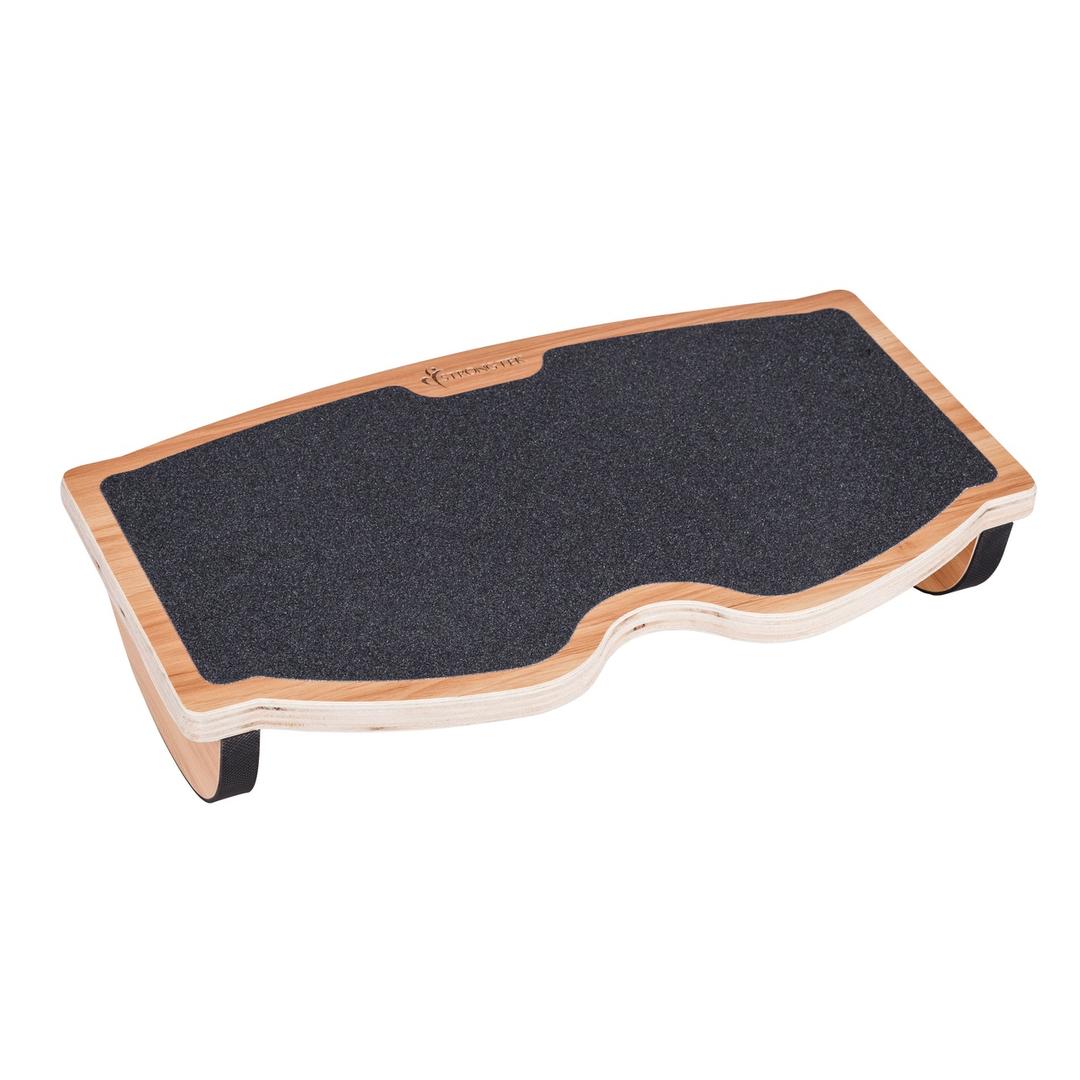
StrongTek Under Desk Footrest
The StrongTek wooden rocker takes a different approach from the HUANUO. Instead of using a plastic adjustable platform, it uses a wooden rocking surface designed to let the feet move forward and backward.
The Amazon-listed FP-100 version measures approximately 17.7 × 10.5 × 4.4 inches and is made from wood. StrongTek describes the design as a rocking footrest that can encourage movement while seated. The product is also listed with a 350-pound capacity.
The main attraction here is not maximum adjustability. It is the simple mechanical movement. If you naturally like to shift your ankles and feet while working, the rocker format can be more engaging than a fixed wedge.
- Wooden construction
- Rocking movement
- Wide platform
- Non-slip surface
- No complicated controls
- Less height-adjustable than HUANUO
- Rocking design is not ideal for everyone
- Occupies more visual/physical space than a simple foam wedge
Best for: users who want an active, rocking footrest and prefer wood over molded plastic.
Check StrongTek on Amazon4. Amazon Basics Foam Foot Rest — Best Simple Budget Choice
Amazon Basics Foam Foot Rest for Under Desk
Sometimes the best ergonomic accessory is the one that does one job without adding unnecessary mechanisms. The Amazon Basics foam footrest is a simple wedge-style option for users who mainly need a raised surface beneath the desk.
The product measures approximately 17.3 × 10.2 × 5.1 inches and uses polyurethane foam with a polyester cover. It has an anti-slip base and a removable washable cover.
There is no height mechanism or rocking platform to configure. That is both its strength and its limitation: if approximately five inches of fixed elevation suits your setup, the simple design is easy to understand and use.
- Simple wedge design
- Soft foam construction
- Washable cover
- Anti-slip base
- Large enough for both feet
- Fixed height
- No rocking function
- Less adaptable to different desk/chair combinations
Best for: users who know roughly how much elevation they need and want a straightforward foam footrest.
Check Amazon Basics on AmazonDo You Actually Need an Ergonomic Footrest?
No—not everyone does.
A footrest is most useful when your desk, chair, and body dimensions do not line up well. For example, you may need to raise your chair to get your arms into a comfortable working position, but that can leave your feet unsupported if the desk is fixed-height.
In that situation, a footrest can bridge the gap without forcing you to lower your chair and compromise your desk position.
If your feet already sit comfortably and fully on the floor, however, a footrest may add little or may even make your lower-leg position less comfortable.
How to Choose the Right Footrest
1. Start With Height
Height is usually more important than material. A beautiful wooden footrest is not useful if it is too tall for your setup.
Adjust your chair first. Then determine whether your feet remain comfortably supported. If not, choose a footrest whose height closes that gap without forcing your knees into an awkward position.
2. Choose Fixed or Adjustable
Fixed foam: best when you know the height you need.
Adjustable: better when several people use the workstation or when your desk/chair combination changes.
Rocking: useful when you prefer gentle foot and ankle movement instead of a completely fixed platform.
3. Check the Platform Size
Your feet should fit comfortably without constantly hanging over the front or sides. Larger platforms are especially useful if you change foot position frequently.
4. Consider Surface Feel
Hard textured plastic, wood, and memory foam feel very different. If you work barefoot or in socks, a softer or smoother surface may be more comfortable. If you work in shoes, a firmer textured surface may make more sense.
5. Check Under-Desk Clearance
A footrest can be ergonomically useful but physically incompatible with a shallow desk area. Measure the available space before ordering, particularly if the footrest has a wide or tall frame.
Footrest vs. Replacing Your Office Chair
A footrest should not be used to compensate for a fundamentally unsuitable chair.
If your chair has the wrong seat depth, poor lumbar fit, inadequate height adjustment, or uncomfortable armrests, a footrest will not fix those problems. But if the chair itself fits you well and your main problem is unsupported feet, a relatively inexpensive footrest can be a much more targeted solution.
That distinction matters. Ergonomics is about the whole interaction between your body, chair, desk, and task, not about buying the maximum number of accessories.
Common Footrest Mistakes
- Buying one without checking height. The wrong height can be worse than no footrest.
- Assuming everyone needs one. If your feet already rest comfortably on the floor, you may not benefit.
- Using a footrest to fix a bad chair. Correct the chair first.
- Ignoring desk clearance. Large footrests need enough space to move naturally.
- Choosing features instead of fit. Massage textures, rocking, and multiple settings are not automatically better.
- Believing “ergonomic” is a guarantee. The actual dimensions and interaction with your body matter more than the label.
Which One Should You Buy?
| If you want… | Our pick |
|---|---|
| The best combination of adjustability and movement | HUANUO Adjustable Foot Rest |
| A soft memory-foam surface | ComfiLife Foot Rest |
| A wooden rocking platform | StrongTek Under Desk Footrest |
| A simple fixed foam wedge | Amazon Basics Foam Foot Rest |
For most users, we would start with the HUANUO because its three height settings and free rocking motion make it adaptable to a wider range of desk setups. If you strongly prefer soft foam, the ComfiLife is the more natural choice. If movement is your priority, choose the StrongTek. And if you simply need a basic elevated surface, the Amazon Basics model keeps things simple.
Frequently Asked Questions
Are ergonomic footrests good for office chairs?
They can be useful when your chair and desk height leave your feet unsupported. They are not universally necessary, and the correct height is more important than the “ergonomic” label.
What height should an office footrest be?
There is no single correct height for every person. The correct height is the one that allows your feet to rest comfortably while your chair remains at a suitable working height. Adjustable models make this easier to achieve.
Is a rocking footrest better than a fixed footrest?
Not necessarily. A rocker is useful if you enjoy changing ankle and foot position. A fixed or foam footrest may be better if you prefer stable support.
Can a footrest replace an ergonomic chair?
No. A footrest addresses foot and lower-leg support. It cannot replace appropriate seat depth, lumbar support, armrest positioning, or other chair adjustments.
Should I buy a foam or hard footrest?
Choose based on how you use it. Foam is generally more cushioned; hard platforms can provide a firmer, more stable reference surface and may offer rocking or height-adjustment mechanisms.
Final Verdict
The best ergonomic footrest is not necessarily the one with the most features. It is the one that solves the specific mismatch between your body, your chair, your desk, and your working position.
For a versatile starting point, the HUANUO offers the strongest combination of height adjustment and movement. The ComfiLife is better for cushioned foam support, StrongTek is the more interesting choice for wooden rocking movement, and Amazon Basics is the straightforward option for users who want a simple fixed-height solution.
Most importantly, treat a footrest as part of an ergonomic setup—not as a magic product. Get the chair and desk position right first, then use the footrest only where it genuinely improves fit and comfort.
Related ErgonomicBest Guides
- Best Ergonomic Office Desk Chairs
- Best Ergonomic Chairs Under $200
- Best Ergonomic Mesh Office Chairs
Editorial note: Product specifications can change. Verify the exact configuration, dimensions, and current listing before purchasing. This article is a product guide, not medical advice.